Below are selected sections from a safety data sheet. A safety data sheet contains important information about a chemical product, such as its name, hazards, safe handling procedures, and transport information. These sections are the ones extracted from safety data sheets and constitute the data delivered through our Sustainability service.
Section 1
Product name
The name of the product or substance/mixture to which the specific safety data sheet refers.
Issue date
The date on which the specific safety data sheet was published.
Note: There may also be a date on the safety data sheet for the version that has been replaced.
Version
The version number of the specific safety data sheet. There may be several versions, as the product can change over time. The version may be formatted in different ways, for example:
• 1, 2, 3, etc.
• V001, V002, etc.
• 1, 1.1, 1.2, etc.
Note: There may also be a version indicated for a safety data sheet that has been replaced.
UFI number
A code used to uniquely identify hazardous mixtures within the European Union. The UFI number is part of the EU’s CLP Regulation, which aims to ensure a high level of protection for human health and the environment. The UFI consists of 16 characters, a combination of numbers and letters, and must be included on the label of any product containing hazardous chemicals.
Section 2
Signal word
The purpose of the signal word is to immediately inform the user of the relative level of hazard associated with a chemical product. There are two signal words that may be used:
• Danger
• Warning
Hazard statement (H-phrase)
Hazard statements are part of the labelling system for chemicals under the CLP Regulation in the EU. There is a predefined set of H-phrases, with rules specifying which may be combined and which must be listed separately. Each H-phrase consists of the letter “H” followed by a three-digit number, for example:
• H220
• H302
By using H-phrases in a consistent way, the labelling helps users quickly identify risks and handle the product safely. In addition, H-phrases determine which GHS pictogram(s) must be used on the product label. These symbols visualise the hazards and make it easier to quickly understand the risks when handling the chemical.
For example, the hazard statements H222 and H229 result in the following pictogram:

Hazard statement (text extension)
H-phrases provide standardised text describing the hazards of a chemical product and help ensure that information about these hazards is consistent and easy to understand. Each H-phrase has a standard text associated with it, for example:
• H220: Extremely flammable gas.
• H302: Harmful if swallowed.
H-phrases are divided into different categories depending on the type of risk they describe:
• Physical hazards – including risks such as flammability, explosiveness, and reactivity.
• Health hazards – including risks such as toxicity, skin irritation, and sensitisation.
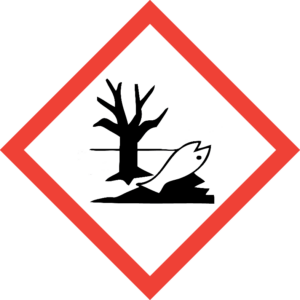
• Environmental hazards – describing risks to aquatic organisms and the environment as a whole.
Supplemental hazard statement (EUH-phrase)
EUH-phrases are specific hazard statements that are part of the CLP Regulation within the EU but are intended for certain hazards that are not covered by the standard H-phrases. EUH-phrases are used to provide additional information on specific risks or to describe particular hazards that are unique to certain substances or mixtures.
EUH-phrases have a similar structure to H-statements, with the letters “EUH” followed by a number, but they often address more specific or particular hazards. For example:
• EUH014
• EUH029
• EUH031
Supplemental hazard statement (text extension)
Like H-phrases, EUH-phrases provide standardised text describing the hazards of a chemical product and help ensure that information about these hazards is consistent and easy to understand. The difference is that EUH-phrases are intended for certain hazards that are not covered by the standard H-phrases. Each EUH-phrase has a standard text associated with it, for example:
• EUH014: Reacts violently with water.
• EUH029: Contact with water liberates toxic gas.
• EUH031: Contact with acids liberates toxic gas.
Precautionary statement (P-phrase)
P-phrases, or precautionary statements, are a critical component of the chemical labelling system under the CLP Regulation in the EU.
Each P-phrase consists of the letter “P” followed by a three-digit number, for example:
• P102
• P280
Precautionary statement (text extension)
P-phrases provide guidance on how to avoid or minimise the risks associated with hazardous chemicals. They are intended to complement the information provided by H-phrases and EUH-phrases by offering concrete advice on the safe handling, storage, use, and disposal of chemical products. Each P-phrase has a standardised text associated with it, for example:
• P102: Keep out of reach of children.
• P280: Wear protective gloves/protective clothing/eye protection/face protection.
P-phrases are divided into different categories depending on the type of preventive measure they recommend:
• General precautionary measures – e.g. advice on storage or how to avoid exposure.
• Precautionary measures for use – including guidance on safe use of the product, protective equipment, and what to do in case of accidental exposure.
• Precautionary measures for storage – advice on safe storage to prevent accidents or degradation of the product.
• Precautionary measures for disposal – instructions on how to safely dispose of the chemical and any potentially contaminated material.
Section 3
CAS number
A CAS number is a unique numerical identifier assigned to every chemical substance that has been described in the literature. CAS, a division of the American Chemical Society, is responsible for creating and maintaining this comprehensive database. The structure of a CAS number typically consists of three groups of numbers separated by hyphens. For example, the CAS number for water is 7732-18-5. The first part can have up to six digits, the second part has two digits, and the third part is a single check digit.
EC number
An EC number is a unique identifier used to identify chemical substances within the European Union. These numbers are part of a system established to register and regulate chemicals on the European market. The EC number consists of seven digits and is formatted as: xxx-xxx-x. For example, the EC number for water is 231-791-2. These numbers are assigned by the European Chemicals Agency (ECHA) and are an important element of the REACH Regulation.
Substances – index number in CLP Annex VI
This is a unique identification number assigned to specific substances to facilitate their classification and labelling. Annex VI is a central part of the CLP Regulation and contains a list of substances and their respective classifications and labelling related to health and environmental hazards.
The index number in Annex VI of the CLP Regulation is formatted as a four-part numerical sequence. It is important to understand that the index number is not just a random value, but is systematically designed to reflect certain information about the substance it represents.
REACH registration number
A REACH registration number is a unique identifier assigned to a chemical substance when it is registered under the REACH Regulation within the European Union. REACH is a comprehensive regulation aimed at protecting human health and the environment from the risks posed by chemicals, while also promoting competitiveness within the EU chemical industry.
Once a substance has completed the REACH registration process, it is assigned a unique registration number. The structure of this number is as follows:
• It consists of 2–12 digits, divided into blocks of 2–3 digits and separated by hyphens.
Format examples:
• XX-XXXXXX-XX-X
• XXX-XXX-XXX
Content of substances in weight percent
The content of substances in weight percent indicates the proportion of each chemical substance or component in a product or mixture, based on its weight. This section of the safety data sheet is crucial as it provides detailed information about the composition of the product, which is necessary for assessing potential risks and determining the safety measures that should be taken during handling, storage, and use of the product.
Flash point
The flash point, expressed in degrees Celsius, is the lowest temperature at which a liquid can emit sufficient vapours to form an ignitable mixture with air near the surface of the liquid. In other words, it is the temperature at which the liquid begins to release vapours that can be ignited by an ignition source. The flash point is a critical indicator of a liquid’s flammability and is used to classify and manage fire hazards.
Section 14
UN number
The UN number is part of the international system for identifying dangerous substances or articles during transport. Key characteristics of UN numbers include:
• They usually consist of four digits. These digits are unique to each substance or article classified as dangerous for transport.
• UN numbers are often preceded by the prefix “UN” to clearly indicate that they are part of the United Nations system for dangerous goods. A typical UN number might look like “UN1993”. In some documents and contexts, only the numeric part may be used without the “UN” prefix.
Proper shipping name
The proper shipping name according to ADR is the official term used to identify dangerous goods during road transport. This designation is part of the international regulations governing the transport of dangerous goods and is intended to ensure that such transport is carried out in a safe and harmonised manner across Europe.
Hazard class for transport
Within ADR, each class or subclass represents a specific type of hazard, making it possible to handle and transport each type of dangerous goods safely. These classes are expressed in a numeric format from 1–9.
Packing group
Within ADR, packing groups are used to classify dangerous substances based on their level of risk, particularly in relation to potential harm or danger in the event of leakage or exposure during transport. These groups indicate the degree of risk and influence the choice of packaging and labelling, as well as the precautionary measures that must be taken during transport.
There are three packing groups in ADR:
• Packing group I (High danger)
• Packing group II (Medium danger)
• Packing group III (Low danger)
Environmental hazards
Within ADR, environmental hazards are a critical aspect to consider when handling and transporting dangerous goods. Environmental hazards refer to the potential risk or damage that a dangerous substance may cause to water, soil, or air environments. ADR regulates the handling of such substances in order to minimise risks to the environment and ensure safe transport. These substances may require specific environmental hazard labelling.