
Structured Product Information
The core idea behind ETIM (European Technical Information Model) is to describe a product’s features in a structured, language-independent, and relevant way based on its specific product class. The ETIM model has become a standard for technical definitions and is used in many European countries, as well as in the USA and Canada. ETIM is used by both manufacturers and wholesalers in the electrical, HVAC, and construction sectors.
In an increasingly digitalised world, access to structured and detailed product data is essential. ETIM helps companies meet these demands by ensuring that product information is not only accurate but also presented in a way that makes it easy to find and use. Whether it's about searching for specific technical attributes or comparing products within a certain category, ETIM simplifies the process.
For a customer searching for a specific fastener, such as a stainless-steel screw with a particular length, diameter, thread type, and head, on an e-commerce site, the ability to filter and find the right product is crucial. If the product characteristics are structured according to the ETIM model, it's easy to create filters that enable these kinds of searches. Without such a standard, it also becomes harder for customers to compare products, leading to a poorer user experience and potentially lost sales.
ETIM is continuously developed by ETIM International, the organization responsible for publishing, maintaining, and promoting the standard. This means the model is constantly adapted to meet new technological and industry-specific needs.
Getting Started
To enrich product attributes according to the ETIM standard, you need to have an agreement for the service. Once in place, enrichment can be done in three ways:
-
ETIM Tool: Export and import attributes via Excel.
-
Directly in the Finfo portal interface.
-
Importing a BMEcat file (a standardised XML file).
Benefits
ETIM offers a wide range of benefits for both suppliers and retailers. As a supplier, you save time and resources by providing product attribute data in a standardized format. As a retailer, you gain access to a structure that makes it easy to manage large volumes of product information. The result is higher quality product data, an improved customer experience, and a more efficient process for finding and comparing products.
-
Enables product information in a structured format
-
No need to gather data from various sources
-
Reduces manual work and increases data quality
-
Ensures an international standard with clear rules and long-term stability
-
Provides consistent definitions of product characteristics – no more comparing apples and oranges
Investing in a clear and standardized model for product attributes like ETIM is an investment in the future – both for suppliers who want to ensure their products are chosen, and for retailers who want to offer their customers a smooth and simple shopping experience.
The ETIM Model
ETIM organises products into product classes and links a set of attributes to each class to describe the product's characteristics. On ETIM CMT, you can search for classes, features, and values.
Groups
A group represents the top-level category for products and serves as the first level in the ETIM model. Groups gather similar product classes, making it easier to organize and search for products.
There are just over 200 groups, for example: Energy distribution systems and Fasteners.
Classes
Within each group, there are specific classes that represent individual product types. A class consists of products with similar technical features and areas of use. All variations of a product—regardless of manufacturer—are grouped into the same class. Each class then has its own specific features and attributes that define the technical characteristics of the products.
There are over 6,000 classes, such as: Cast-iron Pipe, and Concrete Screw.
Synonyms
ETIM uses synonyms to improve search ability and help users find the correct product class. Synonyms are alternative names for a product class, meaning a product may be referred to in several ways depending on the user’s vocabulary. Whether someone searches using a technical term or a more everyday expression, they’ll be guided to the correct class. Synonyms are language-specific and are managed by the local ETIM organization in each country.
For example, the class "Anchor Bolt" has 17 different synonyms in English, such as: Bolt anchor, Concrete anchor, Flat steel anchor, Rail anchor, Screw anchor and Wedge anchor.
Features
Each class has a set of features and attributes that allow for a precise description of the product. These features act as technical parameters that define key aspects of the product. Attributes can be of various types, such as alphanumeric, numeric (length, dimensions), or logical (yes/no).
There are just over 20,000 features, such as: Material, Color, Surface Protection.
Values
Each feature is linked to a predefined set of values. These values help further specify the product within its class and make the information as detailed and accurate as possible.
There are over 18,000 values, such as: Analog, Blue, Hot-dip galvanized.
Units
For numeric attributes, such as length or weight, a specific unit is always required. This ensures all technical details are presented in a consistent and accurate format, making it easier to compare and filter products.
There are nearly 300 different units, for example: Megahertz, Milliliters, Percent, Degrees, Tons.
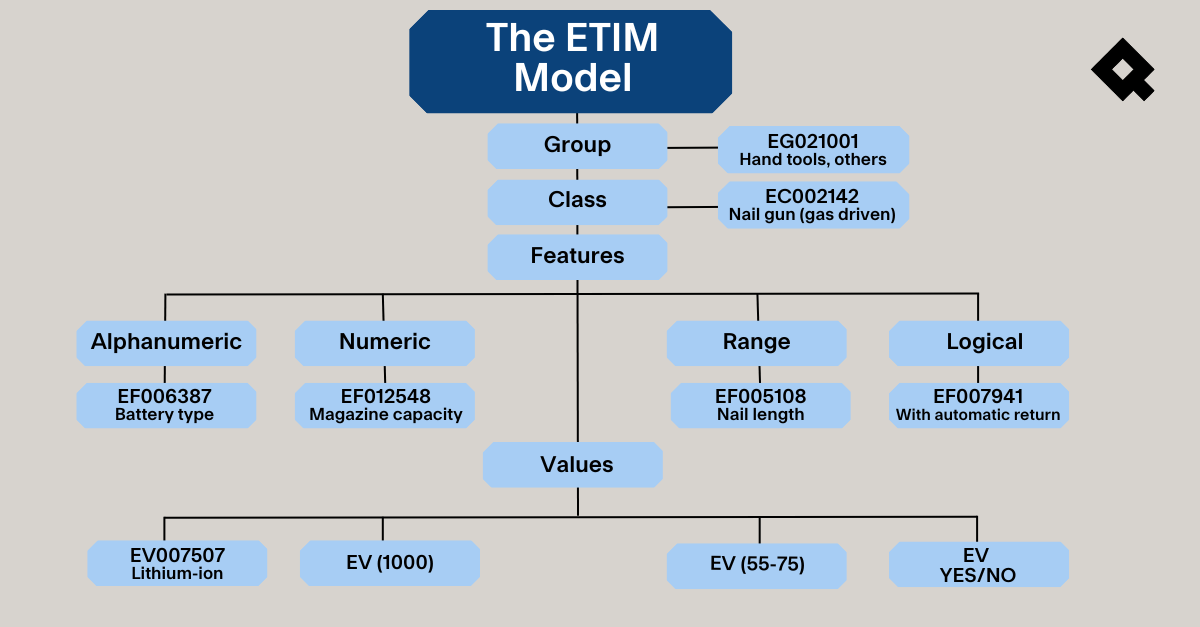
By combining these components, ETIM ensures that product data is easy to understand, compare, and manage, both for suppliers and retailers.
On ETIM CMT, you can learn more about ETIM classes, features and values.
Do you want to be involved in influencing ETIM? Contact Finfo!