
Field codes IN KNUTGKOD | OUT WIUTGKOD | API discontinuationCode
Definition
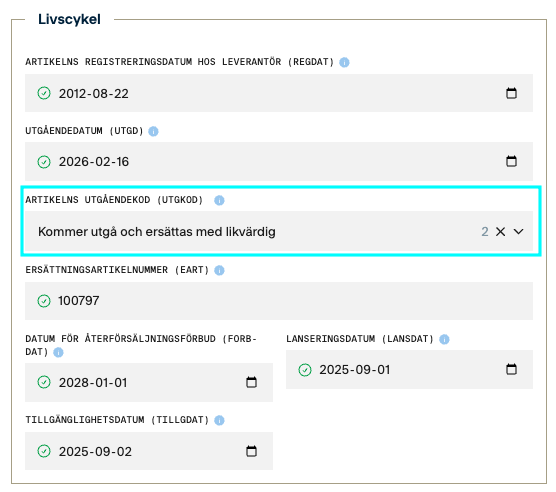
This field specifies which discontinuation code applies to an item that is about to be removed or changed in the assortment.
Explanation
The discontinuation code is used to describe how and why an item is being discontinued. There are six different discontinuation codes, each with a specific meaning, and the code helps recipients manage assortment changes efficiently and correctly (see table below).
By specifying the correct discontinuation code and date, recipients receive clear information about the item’s status and can plan purchasing, inventory, and replacement items accordingly.
The discontinuation code is mandatory if the Discontinuation Date field is completed. These values are entered on the item that is to be discontinued. If the item is to be replaced, the new item number must be specified in the Replacement Article Number field.
|
Code |
Description |
Information |
|---|---|---|
|
01 |
Will be discontinued without replacement |
Initiates a discontinuation process where no replacement article exists. The initiation date is not in the future. Orders and price transactions continue; phase-out planning can begin. The next step is to share status code 4. |
|
02 |
Will be discontinued and replaced with equivalent |
Initiates a discontinuation process where a replacement article exists. The initiation date is not in the future. Orders and price transactions continue; phase-out planning can begin. The next step is to share status code 4. |
|
03 |
Temporarily discontinued |
Used for products temporarily out of assortment (e.g., out of season). The date must not be more than 14 days ahead. This code does not follow codes 01, 02, or 05. Order transactions between seller and buyer stop temporarily. May be followed by code 04 if the article is fully discontinued. Otherwise, the code is removed when the article returns to the assortment. |
|
04 |
Discontinued and sold out |
The article is discontinued. The discontinuation date must not be more than 14 days ahead. This code must always follow codes 01, 02, or 05 but can be used independently if needed. At this stage, all transactions between seller and buyer stop. |
|
05 |
Will be discontinued and replaced with identical equivalent |
Initiates a discontinuation process where an identical replacement exists. The initiation date is not in the future. Orders and price transactions continue; phase-out planning can begin. The next step is to share status code 4. |
|
90 |
Cleanup code for deletion |
Used for incorrectly registered articles that never existed or for discontinued articles with a discontinuation date older than two years and code 04. The code 90 signals that the article can be removed and will not be distributed again. |
If you submit article information via file import, items with discontinuation code 04 only need to be submitted once. After that, the item can be removed from the file, since the information is already registered.
Usage
The supplier specifies a discontinuation code when an item is to be removed from the assortment. A discontinuation code is mandatory if the Discontinuation date field is filled in. If the item is replaced by another item, the new article number must be stated in the Replacement article number field.
Finfo verifies that dates and codes are used correctly, including ensuring that certain codes are not set too far into the future and that a replacement article number is provided where required.
Follow-up is carried out on items that have had discontinuation codes 01, 02, 03 or 05 for an extended period. If an item has had any of these codes for more than one year, the supplier will be contacted and asked to update the code to 04 if the item has now been completely discontinued from the assortment. This ensures that assortment information remains up to date.
Discontinuation code 90 is always subject to extra review and means that the item is placed in quarantine for a period to ensure that all recipients have time to take note of the change. During the quarantine period, the item cannot be reinstated and will be archived in the next archiving cycle.
Recipients use discontinuation codes and dates as a basis for status changes in their systems. The codes affect, among other things, how the item can be ordered, how price updates are handled, and when items should be cleared or archived.